
Why Today’s Hospitality Buyers Are Looking Beyond The Lowest Price To Reduce Costs, Strengthen Supplier Relationships, Protect Margins And Deliver Consistent Guest Experiences
In hospitality, every purchasing decision eventually reaches the guest.
The quality of ingredients influences the dining experience. The reliability of commercial kitchen equipment affects productivity. The availability of linen, amenities and housekeeping supplies determines whether rooms are ready on time. And the performance of suppliers can influence everything from operating costs to service consistency.
Yet procurement professionals are under increasing pressure to achieve what can appear to be conflicting objectives: reduce costs, maintain quality, protect margins, manage supply risks and ensure uninterrupted operations.
For hotels, restaurants, resorts, lodges, catering companies and institutional foodservice operations, the challenge is no longer simply finding the cheapest supplier.
It is finding the right combination of quality, price, reliability, operational efficiency and long-term commercial value.
This is where modern hospitality procurement is changing.
The strongest procurement teams are moving beyond transactional purchasing towards a more strategic approach that connects supplier selection, inventory management, market intelligence, operational performance, risk management and profitability.
The objective is not simply to spend less. It is to spend intelligently, eliminate unnecessary costs and protect the standards that keep guests coming back.
1. The Lowest Purchase Price Is Not Always The Lowest Cost
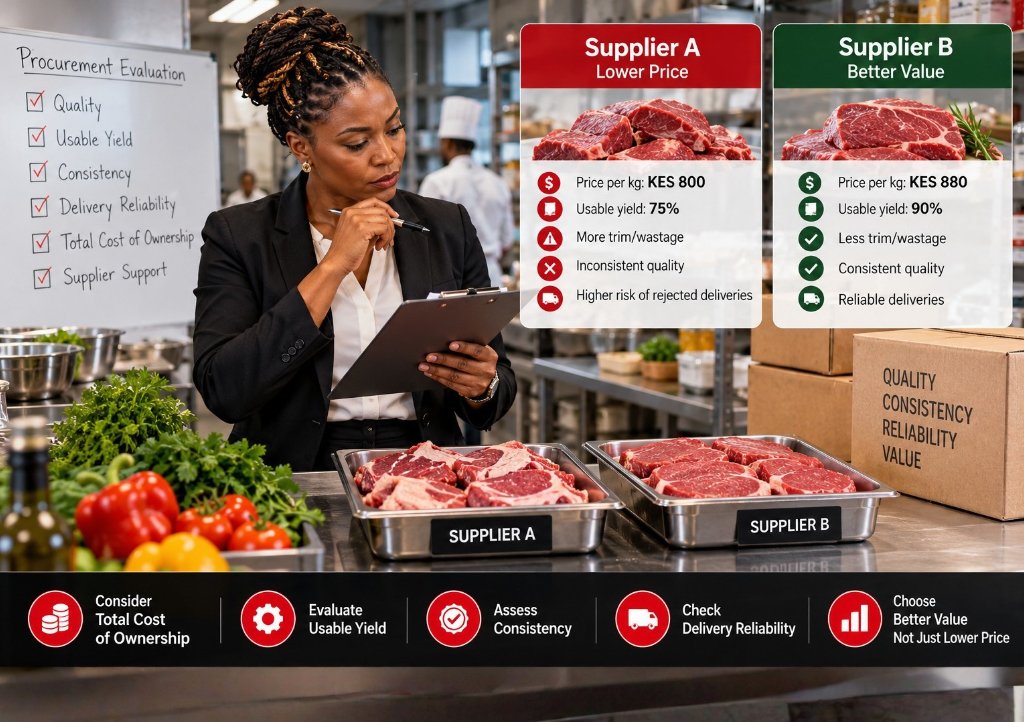
One of the most expensive mistakes in hospitality procurement is evaluating suppliers primarily on quoted price.
A cheaper product can become significantly more expensive when its performance, yield, consistency or operating requirements are taken into account.
Consider two suppliers offering the same category of food ingredient.
Supplier A offers a lower price per kilogram. Supplier B charges slightly more but delivers better usable yield, more consistent quality and fewer rejected deliveries.
The purchasing price favours Supplier A.
The operational economics may favour Supplier B.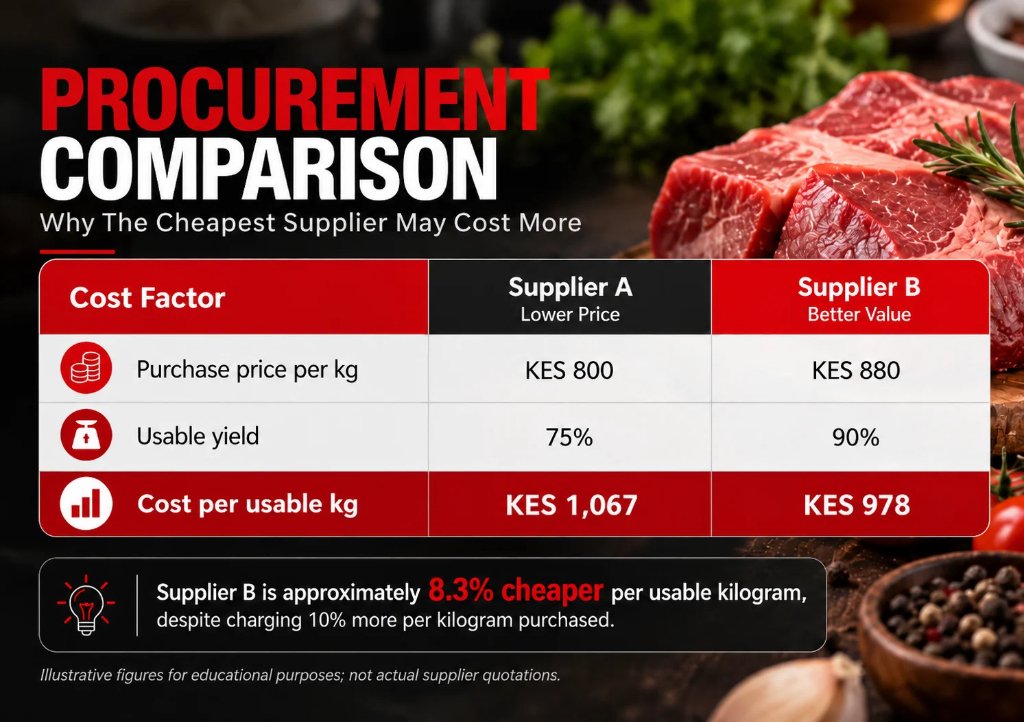
The same principle applies to commercial kitchen equipment, refrigeration, laundry systems, cleaning chemicals, tableware, guest amenities and almost every other procurement category.
A low-cost piece of equipment that frequently breaks down, consumes excessive energy or requires expensive replacement parts can ultimately cost more than a higher-priced alternative.
Professional procurement therefore needs to evaluate total cost of ownership, not simply purchase price.
That includes acquisition costs, transportation, storage, wastage, maintenance, energy consumption, product lifespan, downtime and replacement requirements.
For an Executive Chef, the difference affects food cost.
For a Cost Controller, it affects gross margin.
For a Procurement Manager, it demonstrates why a purchasing decision cannot be evaluated in isolation.
The best buyers do not ask only, “What does it cost?” They ask, “What does it cost us to use?”
2. Supplier Relationships Are Becoming A Competitive Advantage

Successful procurement depends on more than negotiating discounts.
It depends on developing supplier relationships that deliver consistent value.
A reliable supplier understands the operational demands of hospitality: early-morning deliveries, seasonal fluctuations, changing occupancy levels, unpredictable banquet requirements, urgent replenishment and the importance of maintaining consistent specifications.
When procurement teams establish clear expectations, communicate forecasts and evaluate performance regularly, suppliers are better positioned to support the business.
That can translate into improved availability, better delivery planning, fewer emergency purchases, reduced wastage and stronger service continuity.
However, a strong supplier relationship should never mean abandoning commercial discipline.
Professional buyers should maintain clear service-level expectations, agreed specifications, transparent pricing, delivery requirements and measurable performance standards.
Supplier performance should be reviewed against practical criteria such as on-time delivery, order accuracy, product acceptance, response times, price consistency and resolution of complaints.
The strongest relationships combine collaboration with accountability.
And while consolidating purchases with selected suppliers can improve negotiating leverage and simplify administration, excessive dependence on one supplier can expose an operation to unnecessary risk.
Why Supplier Market Intelligence Matters:
Procurement teams need to look beyond their existing supplier relationships. New products, improved equipment technologies, alternative sourcing options and changing industry practices can create opportunities that established purchasing routines may overlook.
This makes access to relevant industry news, supplier information and professional insights increasingly valuable.
Specialised hospitality industry networks such as HORECA KE provide an additional avenue for professionals to follow industry developments, discover products and services, and identify potential supply partners.
The objective is not simply to find more suppliers.
It is to understand the market well enough to make better purchasing decisions.
The strongest procurement departments build better-performing supplier networks, not merely longer supplier lists.
3. Smarter Inventory Management Protects Cash Flow And Margins

Every item sitting in a storeroom represents money that has already been spent.
Too much stock ties up working capital, increases storage requirements and raises the risk of spoilage, damage, expiry and obsolescence.
Too little stock creates a different set of problems: emergency purchasing, interrupted service, menu unavailability, delayed maintenance and dissatisfied guests.
Effective procurement sits between these extremes.
The starting point is understanding actual consumption rather than purchasing according to habit.
Hotels and restaurants should use occupancy forecasts, restaurant covers, banquet schedules, seasonal demand, historical consumption and supplier lead times to guide purchasing quantities.
A beachfront resort preparing for peak season will have different requirements from a city hotel managing weekday corporate demand.
A restaurant hosting a major event will require a different purchasing plan from one operating under normal trading conditions.
Procurement must respond to those realities.
Practical controls include minimum and maximum stock levels, reorder points, accurate stock counts, expiry-date monitoring, standardised specifications and clear receiving procedures.
For food and beverage operations, FIFO (First In, First Out) and FEFO (First Expired, First Out) practices can help reduce avoidable losses when applied appropriately.
Inventory management should also distinguish between high-value items, fast-moving essentials and products with unpredictable demand.
Not every product requires the same level of attention.
A frequently used ingredient with a short shelf life demands different purchasing controls from a durable housekeeping item or specialised replacement component.
The objective is to have the right stock, in the right quantity, at the right time—without unnecessarily tying up cash.
Good inventory management protects both availability and profitability.
4. Digital Procurement Is Replacing Guesswork With Visibility
Hospitality procurement is becoming increasingly data-driven.
Traditional purchasing processes often depend on fragmented communications, spreadsheets, paper quotations and manually maintained supplier records, making supplier discovery, communication and sourcing unnecessarily time-consuming.
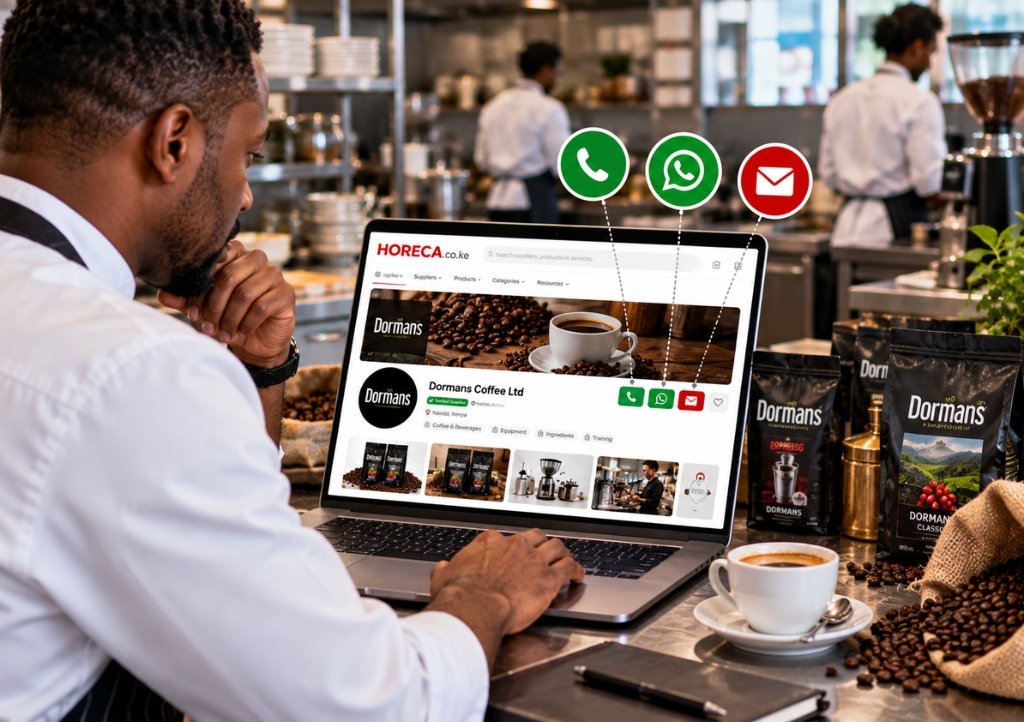
Digital industry platforms such as www.HORECA.co.ke are helping simplify this process by connecting hospitality procurement professionals directly with relevant suppliers, products, services and solutions through a dedicated Supplier Directory.
With convenient click-to-call, direct chat and email RFQ (Request for Quotation) options, buyers can discover potential suppliers, communicate their requirements, request quotations and explore purchasing opportunities more efficiently.
Beyond supplier connections, access to industry insights, emerging product innovations, market developments and professional resources can help procurement teams make more informed purchasing decisions.
Meanwhile, digital procurement management tools help teams organise purchasing requests, compare supplier quotations, track approvals, monitor deliveries and analyse expenditure.
When integrated appropriately with inventory, accounting and operational systems, they can also provide a clearer picture of purchasing patterns and actual consumption.
This does not mean every hotel or restaurant needs an expensive enterprise procurement platform.
The most appropriate technology depends on the size, complexity and operational requirements of the business. Even a relatively simple system that standardises supplier information, purchase orders, approvals and purchasing history can improve accountability.
Supplier Discovery Is Part Of Smarter Procurement
Digital transformation is not limited to automating purchase orders and approvals.
It also changes how hospitality buyers research products, discover suppliers, communicate directly with potential supply partners and evaluate available solutions.
Instead of relying exclusively on existing contacts or general internet searches, procurement teams can use industry-specific directories to broaden their sourcing options and connect directly with relevant suppliers.
However, discovering a potential supplier is only the beginning.
Professional buyers must still assess product suitability, technical specifications, supplier credentials, pricing, after-sales support and commercial terms.
Technology creates visibility.
Procurement expertise turns that visibility into better decisions.
5. Procurement Must Work With Operations, Not Against Them

One of the most important changes in hospitality purchasing is the growing need for collaboration between Procurement, Finance, Kitchen Operations, Food & Beverage, Housekeeping, Engineering and Management.
When these departments work independently, purchasing decisions can create unintended operational consequences.
A Procurement Manager may secure a lower price on cleaning chemicals without fully understanding dilution requirements or compatibility with existing dispensing equipment.
An Executive Chef may request premium ingredients without considering their effect on menu contribution margins.
An Engineering Manager may select equipment based on technical performance without evaluating maintenance costs, spare-parts availability or local servicing capability.
Each department may be acting in good faith.
But the business needs one commercially sound decision.
This is why procurement should be involved early in operational planning, equipment selection, menu development, refurbishment projects and major purchasing commitments.
For commercial kitchen equipment, for example, the evaluation should consider production capacity, workflow, energy efficiency, installation requirements, warranty coverage, after-sales service, training and the availability of technical support.
For food purchasing, it should consider portion yields, menu specifications, product consistency, storage requirements and the relationship between ingredient costs and selling prices.
For housekeeping, the focus may include cost per occupied room, product performance, linen lifespan and consumption controls.
A lower purchase price that increases labour requirements, slows service or reduces product lifespan may create more problems than it solves.
The purchasing department should therefore be part of the commercial conversation—not merely the final approval process.
Good procurement is not about saying no to operational requirements. It is about finding the most commercially effective way to meet them.
6. Sustainable Procurement Must Also Make Commercial Sense

Sustainability is increasingly relevant to hospitality purchasing, but effective procurement requires more than selecting products marketed as environmentally friendly.
Buyers need to assess actual performance, operational suitability and lifecycle costs.
A reusable product may reduce waste and replacement frequency.
An energy-efficient appliance may lower long-term operating expenses.
Locally sourced ingredients may offer freshness, shorter delivery distances and stronger relationships with regional producers.
However, none of these advantages should be assumed without evaluation.
A locally sourced product is not automatically more reliable or less expensive. A sustainable alternative is not automatically suitable for high-volume operations. And a higher-priced energy-efficient machine may not generate sufficient savings if utilisation is low.
The strongest sustainable purchasing decisions connect environmental considerations with measurable operational and financial benefits.
Procurement teams should evaluate durability, resource consumption, waste reduction, packaging, supplier practices and product performance alongside price and service reliability.
For East African hospitality operators, this also means understanding local sourcing opportunities while maintaining appropriate standards of quality, food safety and supply continuity.
Sustainability becomes commercially valuable when it is embedded in purchasing decisions rather than treated as a separate marketing exercise.
Responsible procurement should make commercial, operational and environmental sense.
7. Risk Management Is Now A Core Procurement Responsibility

A supplier failure can become an operational crisis remarkably quickly.
A missed food delivery can disrupt a restaurant’s menu. A refrigeration breakdown can compromise valuable stock. Delayed spare parts can leave essential equipment out of service. A shortage of housekeeping supplies can affect room readiness.
In hospitality, supply-chain disruption does not remain confined to the purchasing department.
It reaches operations, finance and ultimately the guest.
Professional procurement teams therefore need to identify risks before they become emergencies.
That begins with understanding which products, equipment and services are essential to business continuity.
Critical categories should have clearly defined specifications, reliable sourcing arrangements and appropriate contingency plans.
Where practical, procurement teams should qualify alternative suppliers before they are needed, rather than searching for replacements during a crisis.
For imported equipment and specialised products, buyers should consider currency exposure, shipping lead times, customs requirements, spare-parts availability, local technical support and warranty arrangements.
For food and beverage suppliers, risk management should include relevant hygiene and food-safety controls, traceability, product specifications, delivery conditions and documented receiving checks.
Financial and commercial risks also matter.
Procurement teams should assess supplier credibility, payment terms, contract obligations, pricing mechanisms and the consequences of supply interruption.
A Practical Way To Evaluate Supplier Risk
A useful approach is to classify suppliers according to two questions:
How important is this supply to our operation?
How difficult would it be to replace the supplier if something went wrong?
A supplier providing a readily available, low-value consumable presents a different risk from one supplying a specialised refrigeration component with a lengthy import lead time.
Both require procurement oversight.
They do not require identical contingency arrangements.
For essential supplies, buyers should consider maintaining approved alternatives, monitoring supplier performance more frequently and documenting escalation procedures.
Contracts should also be reviewed for realistic delivery commitments, quality obligations, service remedies and termination provisions.
Flexible contracts can be valuable, but flexibility must be balanced against price stability, supply commitments and commercial certainty.
The objective is not to eliminate every possible risk. It is to reduce avoidable exposure and ensure the business can continue operating when something goes wrong.
8. The Best Procurement Teams Measure Savings That Actually Reach The Bottom Line

A procurement department can report impressive negotiated savings while the business continues to experience rising operating costs.
That is because negotiated savings and realised savings are not necessarily the same thing.
A supplier may agree to a lower unit price, but if consumption increases, wastage remains uncontrolled or deliveries become less reliable, the expected financial benefit may never materialise.
The real question is whether purchasing improvements translate into measurable operational and commercial results.
Procurement teams should therefore track more than supplier discounts.
THE PROCUREMENT PERFORMANCE SCORECARD
|
KPI |
What It Tells Management |
|---|---|
|
Purchase price variance |
Whether agreed prices are being maintained |
|
Cost per usable unit |
What the operation actually pays for usable product |
|
On-time delivery |
How reliably suppliers meet commitments |
|
Order accuracy |
Whether correct products and quantities arrive |
|
Stock turnover |
How efficiently inventory is being managed |
|
Wastage and spoilage |
How much purchased value is being lost |
|
Emergency purchases |
Whether forecasting and supplier planning are working |
|
Equipment lifecycle cost |
The longer-term cost of ownership |
|
Realised procurement savings |
Whether purchasing improvements produce financial benefits |
These indicators become more powerful when connected to operational performance.
For restaurants, purchasing decisions influence food cost percentage, gross profit, menu contribution margins and inventory losses.
For hotels, procurement affects departmental operating costs, cost per occupied room, maintenance expenditure and overall profitability.
For catering and institutional foodservice businesses, ingredient yield, production volumes, purchasing consistency and cost per meal can be particularly important.
Importantly, savings should be calculated against credible baselines and adjusted where necessary for changes in volume, product specifications and service requirements.
Otherwise, a reduction in expenditure may simply reflect fewer guests, lower purchasing volumes or a reduction in quality.
Real procurement success means achieving better commercial outcomes without weakening operational performance or the guest experience.
9. Procurement Is Becoming A Strategic Hospitality Leadership Function
The modern Procurement Manager is no longer simply the person responsible for obtaining quotations, negotiating prices and issuing purchase orders. The role increasingly requires commercial awareness, supplier-market intelligence, operational understanding, analytical capability and sound risk judgment.
That means understanding the relationship between purchasing decisions and the broader performance of the business.
It means working with Executive Chefs to improve ingredient yields, with Finance to protect cash flow, with Engineering to evaluate equipment investments and with Operations to maintain consistent service standards.
It also means recognising when the lowest-priced quotation is the right choice—and when paying more delivers better value.
Successful procurement leaders balance competing priorities without losing sight of the organisation’s commercial objectives.
They know which categories deserve strategic attention, which suppliers are genuinely performing, where unnecessary costs are accumulating and where better purchasing decisions can create measurable value.
Staying informed is part of that responsibility.
Professional industry resources, supplier networks, market insights, product developments and relevant training opportunities can help procurement teams maintain the knowledge needed to make confident decisions in a changing hospitality environment.
The strongest procurement departments do not simply process purchasing requests.
They actively contribute to profitability, operational resilience and the quality of the hospitality experience.
10. The Future Belongs To Buyers Who Think Beyond Price
Hospitality businesses will continue facing pressure to control costs while delivering the quality, reliability and experiences their customers expect.
That makes professional procurement more important—not less.
The opportunity is not to pursue cheaper products at every turn.
It is to eliminate unnecessary expenditure, improve supplier performance, manage inventory intelligently, invest in appropriate technology and make purchasing decisions based on measurable value.
For Procurement Managers, Purchasing Officers, Cost Controllers and hospitality decision-makers, the competitive advantage will increasingly come from knowing their suppliers, understanding their numbers and collaborating closely with the departments they support.
Because the most effective procurement teams do more than protect the purchasing budget.
They protect the operation.
They protect the guest experience.
And they protect the profitability of the business.
Smart procurement is not about buying cheaper. It is about buying smarter.

 Are You A HORECA PROFESSIONAL?
Claim Your FREE HORECA KE Membership Here >>> https://www.horecaafrica.com/professionals
 Are You A HORECA SUPPLIER?
Join The HORECA KE SUPPLIER Network Here >>> https://www.horecaafrica.com/suppliers
To Stay Ahead In The HORECA Industry